
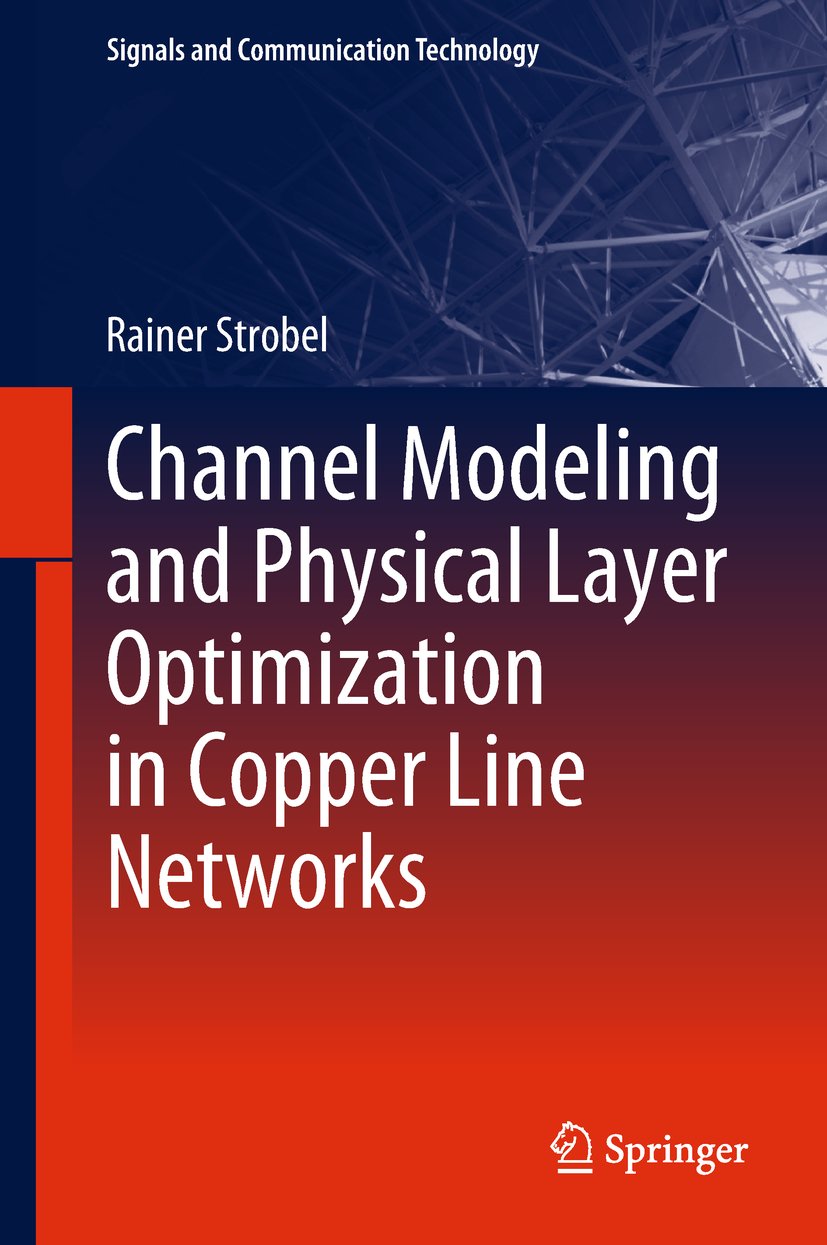
Channel Modeling and Physical Layer Optimization in Copper Line Networks (Signals and Communication Technology)
Product details
| Management number | 233489012 | Release Date | 2026/06/27 | List Price | $34.53 | Model Number | 233489012 | ||
|---|---|---|---|---|---|---|---|---|---|
| Category | |||||||||
This book investigates the physical layer aspects of high-speed transmission on twisted-pair copper wires, where the most performance-critical components are multi-input multi-output (MIMO) precoding and multi-line spectrum optimization as well as optimized scheduling of the transmission time slots on the fiber to the distribution point (FTTdp) copper link. The book brings theoretical results into the implementation, which requires the introduction of realistic channel models and more practical implementation constraints as found in the copper access network.A good understanding of the transmission medium, twisted-pair telephone cable bundles is the basis for this work. Starting from the analysis of measurement data from twisted-pair cable bundles at high frequencies, it presents a MIMO channel model for the FTTdp network, which allows the characteristic effects of high-frequency transmission on copper cable bundles in simulation to be reproduced and the physical layer transmission methods on the copper channels to be analyzed and optimize.The book also presents precoding optimization for more general power constraints and implementation constraints. The maximization of data rate in a transmission system such as G.fast or VDSL is a combinatorial problem, as the rate is a discrete function of the number of modulated bits. Applying convex optimization methods to the problem offers an efficient and effective solution approach that is proven to operate close to the capacity of the FTTdp channel.In addition to higher data rates, low power consumption is another important aspect of the FTTdp network, as it requires many access nodes that are supplied with power from the subscriber side over the twisted- pair copper wires. Discontinuous operation is a method of quickly adding and removing lines from the precoding group. To implement this, the system switches between different link configurations over time at a high frequency. The transmission times of all lines are jointly optimized with respect to the current rate requirements. Discontinuous operation is used to save power, but also makes it possible to further increase the data rates, taking the current subscriber traffic requirements into account. These methods are compared with theoretical upper bounds, using realistic channel models and conditions of a system implementation. The performance analysis provides deeper insights into implementation complexity trade-offs and the resulting gap to channel capacity. Read more
| ASIN | B07DWV9KK7 |
|---|---|
| XRay | Not Enabled |
| ISBN13 | 978-3319915609 |
| Edition | 1st ed. 2019 |
| Language | English |
| File size | 33.0 MB |
| Page Flip | Enabled |
| Publisher | Springer |
| Word Wise | Not Enabled |
| Print length | 370 pages |
| Accessibility | Learn more |
| Screen Reader | Supported |
| Part of series | Signals and Communication Technology |
| Publication date | June 20, 2018 |
| Enhanced typesetting | Enabled |
Bestseller ranking
Electronics




Customers who viewed this product also viewed
Helmets





Correction of product information
If you notice any omissions or errors in the product information on this page, please use the correction request form below.
Correction Request Form